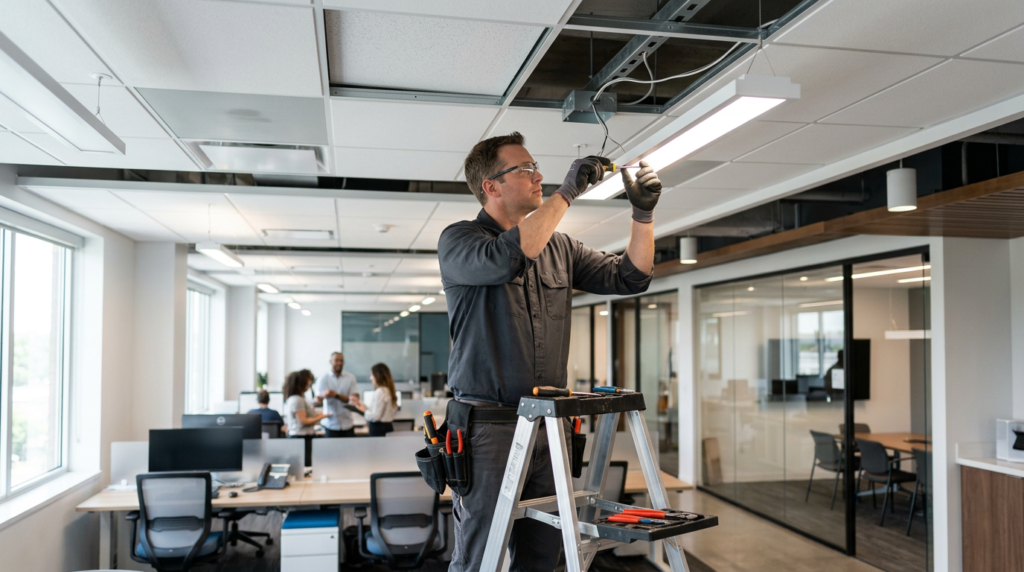
Quick answer: For most commercial lighting repairs in DuPont—especially anything involving branch circuits, breakers, fixture wiring, or new installations—call a licensed electrician. Nextech’s role is HVAC and controls; they can help when lighting schedules, occupancy signals, or building automation are affecting comfort or run-times, and they can coordinate with an electrician if needed. If you smell burning or have repeated breaker trips, shut the circuit off and call an electrician.
What “Commercial Lighting Service” Usually Includes
Nextech does not function as your commercial electrician for lighting repairs; they’re an HVAC and controls provider, so you’d call a licensed electrician for fixture wiring, circuit issues, and installations, and involve Nextech when lighting controls overlap with HVAC/BAS scheduling.
Commercial lighting service typically covers troubleshooting and repairing fixtures (LED troffers, high bays, wall packs, canopy lights), replacing failed lamps or LED drivers, fixing ballasts in older fluorescents, and resolving control problems like motion sensors, daylight sensors, timers, and dimmers. Many calls start with a simple complaint—flicker, sections out, or lights that won’t shut off—but the fix can range from a quick component swap to tracking down a loose neutral or failing contactor.
If you’re searching for DuPont commercial lighting services, it helps to know what you’re actually asking for: “service” can mean emergency repair, planned maintenance (cleaning lenses, checking connections, testing controls), or upgrades (retrofit kits, new fixtures, and control reprogramming). In many commercial spaces around DuPont—retail bays, medical/office suites, light industrial, and warehouses—after-hours access and lift needs often drive scheduling as much as the repair itself.
Retrofits can also trigger local process questions: swapping lamps/drivers is usually straightforward, but adding new circuits, moving fixtures, or changing emergency/egress lighting layouts may require permits and inspections. If you’re considering a larger upgrade, it’s also smart to ask your utility about any rebate paperwork timing, since some programs require pre-approval before equipment is purchased.
Signs It’s More Than a Burned-Out Bulb
A dead lamp is common, but repeated failures in the same spot usually point to an underlying issue. Watch for flicker that worsens over time, buzzing from fixtures, discoloration around sockets, or lights that change brightness randomly. Those symptoms can indicate a failing driver/ballast, overheating in a fixture, or a loose connection that’s arcing.
Breaker trips, warm switch plates, a burning odor, or multiple fixtures going out at once are red flags. Shut the circuit down if you can and call an electrician—those are electrical-safety problems, not “replace a bulb” problems. If you have LED retrofits in older housings, compatibility problems (dimmer type, sensor load limits, driver quality) can also cause strobing or early driver failure.
For warehouses and high ceilings, don’t ignore slow-starting lights or lights that take minutes to reach full output. That can signal driver issues or control problems that will likely get worse, and it often affects safety and productivity.
A Quick Checklist For Your Service Call
Use this checklist on the phone so the right person shows up with the right parts and access plan:
Checklist: Symptom (out, flicker, dim, won’t turn off, trips breaker); scope (one fixture, one row, whole area); fixture type (LED panel/troffer, high bay, exterior wall pack, canopy); control type (switch, dimmer, occupancy sensor, photocell, time clock, relay panel/BAS); safety red flags (burning smell, heat, buzzing, scorch marks, breaker trips); access needs (ceiling height, ladder vs. lift, roof access for photocells, locked electrical rooms); timing constraints (after-hours work, tenant hours, noisy work limits).
Stop troubleshooting and call a licensed electrician immediately if you have breaker trips, burning odor, visible arcing/scorching, water intrusion into fixtures, or any need to open panels or rework wiring. Facilities teams can often handle simple lamp/driver swaps only when power can be safely isolated and the work stays within the fixture’s listed components.
How HVAC and Lighting Can Overlap
Lighting and HVAC intersect more often than people expect. Occupancy sensors and schedules can influence thermostat setbacks, ventilation rates, and after-hours operation. If a space is suddenly “occupied” all night because a sensor is stuck on, you can end up heating, cooling, or ventilating longer than intended.
Heat from older lighting can also affect comfort complaints near ceilings or in small rooms. Upgrading to LEDs can reduce that heat load, but it may change how quickly a space warms up or how often equipment cycles. Coordinating changes helps avoid chasing “mystery” comfort issues after a lighting project.
If the issue appears tied to BAS scheduling, occupancy integration, or spaces conditioning at the wrong times, start with your HVAC/BAS provider; for branch-circuit problems, fixture wiring, or new lighting installs, call a licensed electrician. If you need help sorting out the controls side and coordinating with the right trade, Nextech can help.